Dry Coolers vs Cooling Towers and Chillers: How do they compare?
Selecting the appropriate heat-rejection technology is a critical engineering decision that affects energy consumption, water use, system stability and lifecycle performance. Dry Coolers, Cooling Towers and Chillers each follow different thermodynamic principles and serve distinct operating envelopes. For engineers in process industries and HVAC design, understanding these differences is essential to optimise plant performance, OPEX and reliability.
Role and Operating Concept of the Three Technologies
Dry Coolers, Cooling Towers and Chillers are often considered alternative solutions, yet their operating principles are fundamentally different.
The engineering challenge lies in selecting the right mix: evaluating thermal duty, climate, water strategy, redundancy and system architecture. Find out more about industry-specific cooling solutions in our industry section.
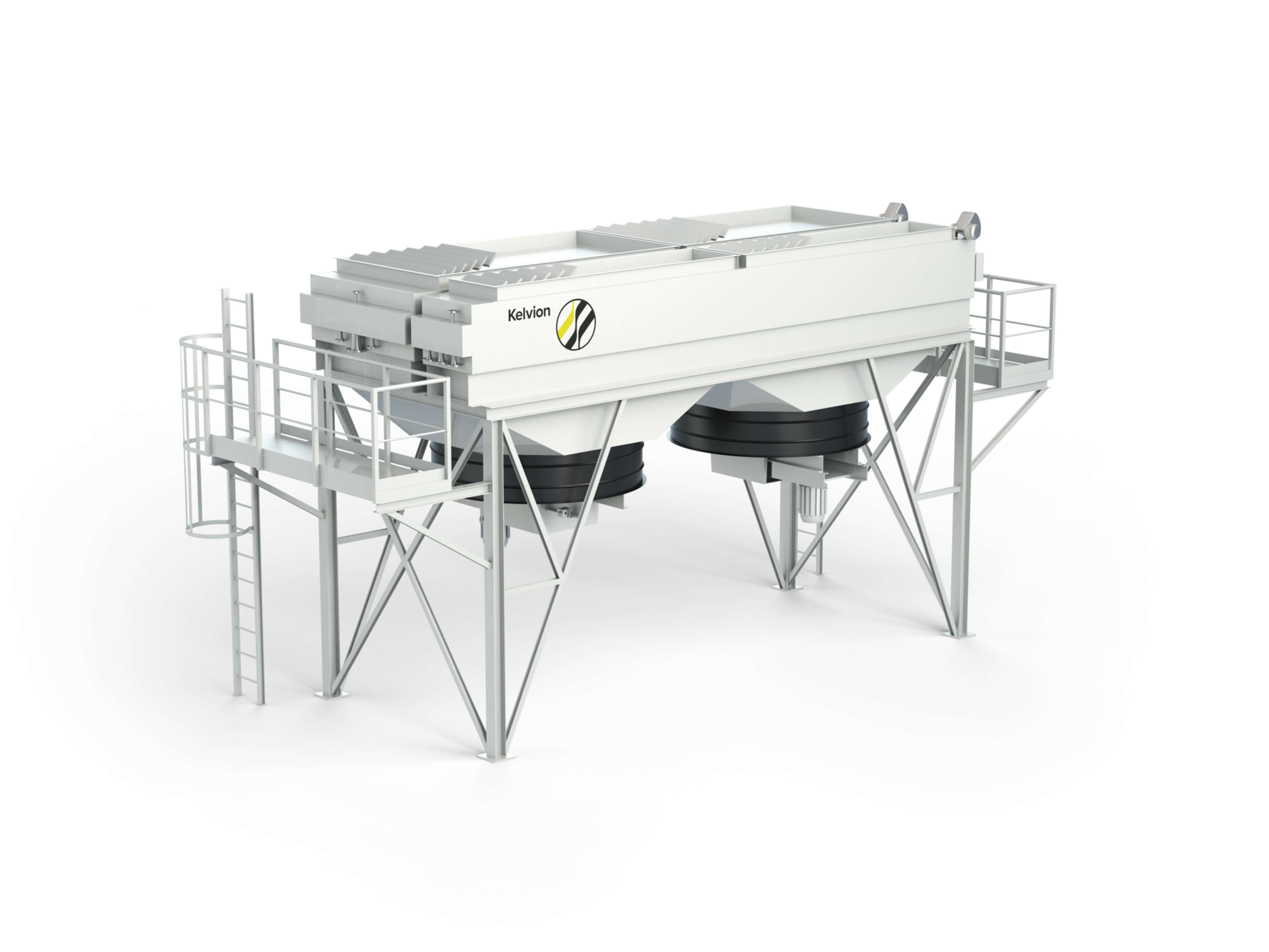
Closed-circuit, air-cooled systems using finned-tube coils and forced convection.
- no evaporation, no water consumption
- highly predictable operation across seasons
- suitable for closed-loop fluid circuits and free cooling
Evaporative heat-rejection systems using direct contact between water and air.
- rely on evaporation to achieve cooling below dry-bulb temperature
- require water treatment, drift management and blowdown
- highly efficient at moderate and high wet-bulb conditions
Mechanical refrigeration units providing precise temperature control.
- not primarily heat-rejection devices, but cooling sources
- require a condenser system, either air-cooled or water-cooled
- often used in combination with Dry Coolers or Cooling Towers
Dry Cooler vs Cooling Tower
This comparison is primarily driven by water availability, environmental requirements and target temperature levels.
Thermodynamic principle
- Cooling Towers cool towards wet-bulb temperature, which is usually significantly lower.
- As a result, Cooling Towers achieve lower outlet temperatures.
Water management
- require continuous make-up water
- drift eliminators
- blowdown cycles
- anti-corrosion and biocide treatment
Maintenance & reliability
Cooling Towers require:
- fan system maintenance
- basin cleaning
- scale control
- microbiological monitoring (Legionella risk)
Use cases
Cooling Towers: large refinery duties, high-tonnage cooling, low temperature approach needed.
Thermodynamic principle
- Dry Coolers cool towards dry-bulb temperature.
- As a result, Dry Coolers offer complete water independence.
Water management
- no water circuit open to the environment
- no chemical dosing
- elimination of plume formation
- simplified permitting and fewer environmental interfaces
Maintenance & reliability
Dry Coolers require:
- fin cleaning
- fan and motor inspection
- far fewer contamination-related interventions
Use cases
Dry Coolers: water-restricted sites, chemical plants, data centres, closed-loop systems, free-cooling strategies.
Dry Cooler vs Chiller
A Dry Cooler is fundamentally a heat-rejection device, whereas a Chiller is a cooling-generation device. They are often complementary, not interchangeable.
Operating principle
- Chillers use a mechanical refrigeration cycle (compressor → condenser → expansion → evaporator).
Temperature control
- Chillers provide precise, low-temperature supplies (0–20°C based on design).
Integration
Chillers can be:
- air-cooled (with condenser coils and fans)
- water-cooled (requiring a Cooling Tower)
Cost and complexity
- Chillers involve higher CAPEX and OPEX due to compressors, refrigerants and controls.
When to use what
- Use Chillers for precise or sub-ambient temperature requirements.
Operating principle
- Dry Coolers reject heat via air-cooled convection.
Temperature control
- Dry Coolers depend on ambient conditions and cannot cool below ambient air temperature.
Integration
Dry Coolers can:
- serve as free-cooling units for chillers
- offload chillers during cold seasons
- replace condensers in specific system designs
Cost and complexity
- Dry Coolers offer simpler operation and lower lifecycle complexity.
When to use what
- Use Dry Coolers when ambient conditions allow free cooling, or when mechanical refrigeration should be minimised.
Dry Cooler vs Fluid Cooler
Both technologies are closed-loop systems, but their cooling mechanisms differ.
Fluid Coolers are typically selected when lower outlet temperatures are required than a Dry Cooler can provide, but without exposing the process fluid directly to evaporation.
- purely air-cooled
- water-free
- simpler design
- limited to dry-bulb temperature
- hybrid between Dry Cooler and Cooling Tower
- use evaporative cooling around a closed loop
- achieve lower temperatures than a Dry Cooler
- require water management (pump, basin, treatment)
- have higher maintenance complexity
Dry Cooler vs Air-Cooled Chiller
An air-cooled chiller integrates a refrigeration cycle and uses air-cooled condenser coils, essentially combining a Chiller and a Dry Cooler concept.
Thermodynamic behaviour
- Dry Coolers cool towards ambient and cannot provide sub-ambient cooling.
Efficiency
- At lower ambient temperatures, Dry Coolers significantly outperform air-cooled chillers because fans dominate energy consumption, not compressors.
Maintenance
Dry Coolers require:
- mainly fan and fin maintenance
- simpler power and control architecture
Use cases
- Dry Coolers: free cooling, closed-loop circuits, heat-rejection components, water-free infrastructures
Thermodynamic behaviour
- Air-cooled chillers cool below ambient due to refrigerant evaporation.
Efficiency
- At lower ambient temperatures, Dry Coolers significantly outperform air-cooled chillers because fans dominate energy consumption, not compressors.
Maintenance
Air-cooled chillers require:
- Air-cooled chillers require:
- compressor maintenance
- refrigerant leak management
- more complex controls
Use cases
- Air-cooled chillers: precise cooling for HVAC and industrial processes
System Selection Considerations
Selecting the right technology requires a clear view of boundary conditions:
- climate (dry-bulb vs wet-bulb profiles)
- required process or supply temperatures
- water availability and cost
- environmental permitting
- redundancy concepts (N+1 or 2N)
- noise limits
- footprint and structural constraints
- OPEX expectations (electricity vs water vs chemicals)
- maintenance philosophy
In water-scarce regions, Dry Coolers shift the dependency to electricity only. Cooling Towers provide maximum thermal performance where low approach temperatures are non-negotiable. Chillers deliver precise, sub-ambient temperature control but with higher mechanical complexity.
Hybrid configurations combine these technologies strategically to balance energy, capacity and environmental constraints.
FAQ: Dry Coolers vs Cooling Towers and Chillers
If water scarcity, environmental regulation, chemical consumption or plume formation are key concerns, Dry Coolers are typically preferred.
No. A Dry Cooler cannot cool below ambient temperature and therefore cannot replace mechanical refrigeration where precise chilled-water temperatures are needed.
Dry Coolers, due to the absence of water treatment, basins, pumps, refrigerants and evaporative components.
Fluid coolers are a hybrid solution allowing evaporative cooling without exposing the process fluid to the atmosphere. They offer lower temperatures than Dry Coolers but require water management.